|
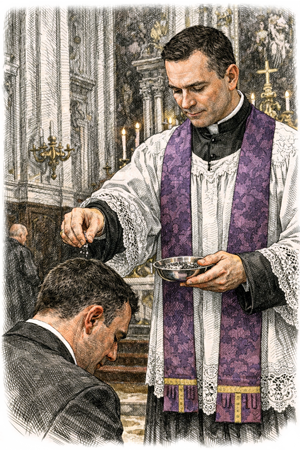
Imposition of Ashes on Ash Wednesday
The rubric in the ritual states that ashes
are imposed on the head. Although it does not specify the manner of
imposition, sprinkling is what was envisioned.This more ancient Roman manner, i.e., sprinkling them on the crown of
the head, is actually the traditional practice. It emphasizes the
biblical gesture of penitence through ashes placed upon the head and
the humility with which we begin Lent.
In some regions, it has become customary
over the years to impose ashes with the thumb, tracing a cross on the
forehead. This is permitted in the United Roman-Ruthenian Church.
However, the traditional method of sprinkling the ashes on the top of
the head is the preferred standard within the Catholicate of
Rome-Ruthenia, as well as throughout theUnited Roman-Ruthenian Church.
While the visible cross of ashses has
become customary in various parts of the world and can serve a purpose
of witness, nevertheless the purpose of this rite is not witness but
penance. The deeper meaning of Ash Wednesday is interior repentance.
Bowing the head and receiving ashes quietly reminds us that Lent is
about conversion of heart.
When using the form of sprinkling, the
officiant takes a small amount of ash in between the thumb and
forefinger and sprinkles it on the crown of the head of the recipient.
The recipient kneels and bows the head to receive the ashses. Clergy
wearing the zucchetto remove it for this rite.
Given
at Rome-Ruthenia in the House of Sts. Peter, Andrew, Stephen, and Mark
this 18th Day of February in the two thousand twenty sixth year of the
Incarnation.
[Divine Liturgy]
[Main Page]
|
