|
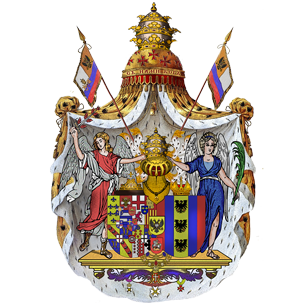
Religious-Dynastic
and State Orders
of
the Pontifical Imperial State of Rome-Ruthenia
(United Roman-Ruthenian Church)
Supreme Pontiff | Roman-Ruthenian Curia | College of Cardinals | Pontifical Court | Liturgy
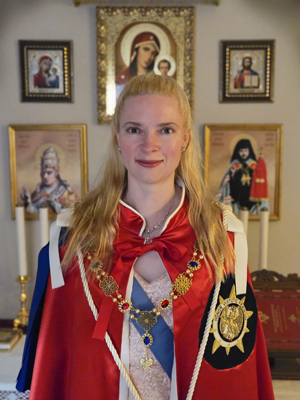 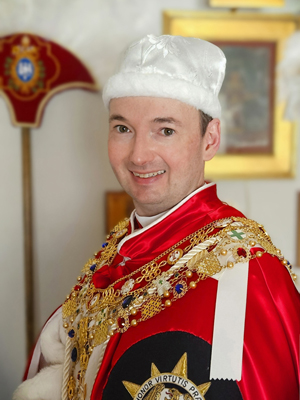
Their
Apostolic Highnesses the Roman-Ruthenian Pope (right)
and the Apostolic Princess of Rome-Ruthenia (left)
in the senior chivalric regalia of the Roman-Ruthenian Church and State.
Few institutions in the world preserve the
continuity, symbolism, and moral architecture of the ancient Orders of
Knighthood. Among these, the Orders of the United
Roman-Ruthenian Church stand as distinguished expressions of
Apostolic and sovereign tradition.
The United Roman-Ruthenian Church, an autocephalous Church uniting
Orthodox and Catholic heritage, maintains and continues its historic
Orders of Chivalry while establishing certain new ones in faithful
continuity with the Church’s mission. These Orders recognize
individuals whose lives reflect exceptional service to the Church, to
Christian civilization, and to the common good.
The Orders serve as visible embodiments of the virtues long upheld
within the Apostolic tradition: piety, courage, charity, fidelity, and
sacrificial service.
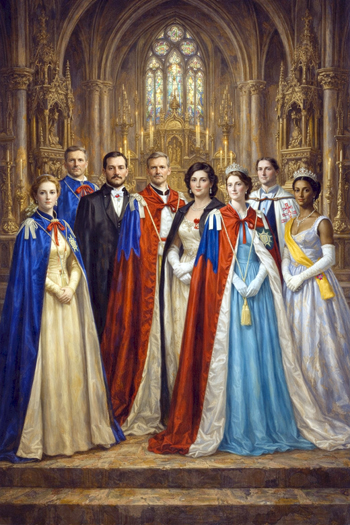
A depiction of knights
and dames of various Orders of Chivalry of the Roman-Ruthenian Church
and State.
(Image from the book Form and Witness: The Living Order of the
Pontifical Court.)
Within the honours framework of the Church are five principal Orders:
The Most Holy Pontifical Orders of Christ and the Eagle
The Religious & Military Order of Sts. Anne and Alexander Nevsky
The Companions of the Pontifical Order of the Eagle
The Order of Sts. George and Olga
The Order of the Pontifical Imperial State
In
addition, other historic and affiliated Orders exist within the
spiritual protection of the Apostolic Household, including the
Russian-Yugoslavian Order of St. John.
Each Order possesses its own character, statutes, and criteria for
admission. Investiture is conferred by authority of the Roman-Ruthenian
Pope upon those who have demonstrated sustained and meaningful service
aligned with the mission and values of the Church.
Membership
in these Orders is not obtained by request, nor conferred lightly. It
follows discernment, proven merit, and fidelity to the principles of
Christian chivalry. Investiture carries with it lifelong responsibility
to uphold the virtues and standards the insignia represent.
As with historic chivalric institutions, investiture in the Orders is
accompanied by the customary offering established according to rank, in
support of the spiritual, cultural, and charitable works of the Church.
Such offering accompanies recognition but does not substitute for merit.
The
Orders of Knighthood of the United Roman-Ruthenian Church remain living
institutions, not relics of the past, calling forth integrity, service,
and honor in the modern world.
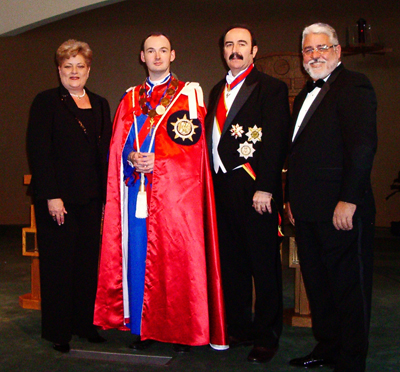
L-R:
Lady Rivera, H.A.H. Pope Radislav I of Rome-Ruthenia, H.M.S.H. Prince
Daniel Coberly of Reichenberg, and H.E. Chev. Rivera during an
investiture.
Religious-Dynastic
Orders
The Most Holy Pontifical Orders of Christ and the Eagle
Religious & Military Order of
Saints
Anne and Alexander Nevsky
The Joint Pontifical Orders of the Eagle
Order
of Saints George and Olga
Order of the Pontifical Imperial State
The Russian-Yugoslavian Order of St.
John
Pontifical Order of Knights Bachelor
of Yugoslavia
Noble
Company of St. Mary of Walsingham
State
Orders of the Stato Pontificio Imperiale
Pontifical Order of Knights Bachelor of Yugoslavia
Wear of Deocrations of the Pontifical and Imperial Orders
Order
of Precedence of the Orders
The Noble Code of Chivalry
Fons Honorum - Legitimate Conferral of Orders and Honours
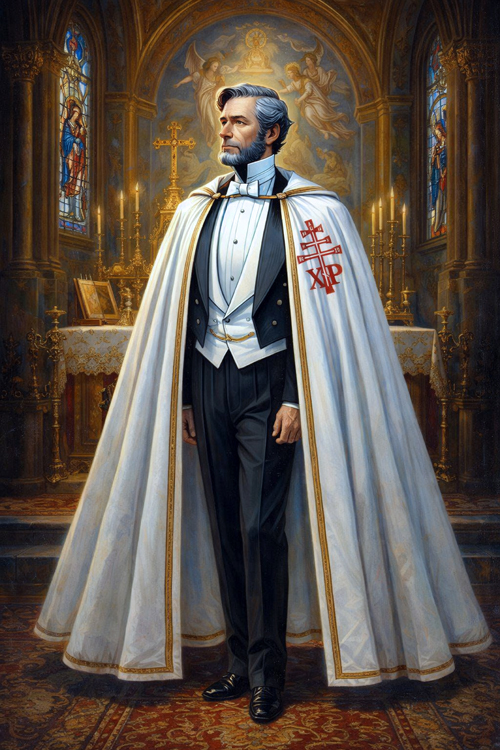
General chivalric cape
of the United Roman-Ruthenian Church,
which may be used by any knight.
(Image
from the book Cloth and Colour: Visible Signs of the Pontifical Court)
|
