|
PONTIFICIVM COLLEGIVM
GEORGIANVM FORMERLY ST. GEORGE THEOLOGICAL
SEMINARY The principal theological seminary of the United Roman-Ruthenian Church FOUNDED 1987 BY ST. EDWIN CAUDILL. CONTINUED BY APOSTOLIC MANDATE IN PERPETUITY. Supreme Pontiff | Roman-Ruthenian Curia | College of Cardinals | Pontifical Court | Liturgy
Pontifical
Georgian College is a private theological institution that serves as
the historic and principle seminary of the United Roman-Ruthenian
Church. The College employs a Competency-Based Education (CBE)
model, a proven approach designed to form clergy and lay scholars with
both excellence and efficiency. Rather than binding students to
inflexible schedules or uniform pacing, CBE allows each learner to
progress according to demonstrated mastery. Those who arrive with prior
knowledge or significant ministerial experience may move quickly
through familiar material, while areas that are new, complex, or
pastorally significant can be approached with greater depth and
reflection. This model respects the diversity of backgrounds within the
Church, honors the maturity and vocation of adult learners, and ensures
that every graduate is formed not simply by time spent in a classroom,
but by demonstrated competence in theology, Scripture, liturgy, and
pastoral practice. The United Roman-Ruthenian Church is an autocephalous Apostolic Church of ancient origins and Orthodox and Catholic heritage. The Church is in special consultative status with the United Nations Economic and Social Council since 2019.
Chaplain Certification and Licensing Pontifical College of Chaplains
Historical Document
Excerpts General Information Standard
Academic Progress Chart
FOUNDED
BY SAINT
EDWIN CAUDILL The college serves the needs of the United Roman-Ruthenian Church, conferring ecclesiastical academic honours on behalf of the Church's Holy Apostolic See under the authority of the Diocese of Rome-Ruthenia. The College also fulfills the mandate of service through scientific enquiry and field research. PGC was founded in 1987 as Saint George's School of Theology (renamed to St. George Theological Seminary when reactivated in 2008) and was based in San Antonio, Texas. It is historically affiliated with Rome, Italy, and Oxford, England, at at the time of its founding by St. Edwin Caudill, it was part of the Diocese of the Southwest, of which the United Roman-Ruthenian Church is the direct, documented legal successor. From its beginning, the seminary maintained a formal affiliation with Wolsey Hall, Oxford, England, and was the exclusive administrator of the theology programme in the United States. Although the College continues a cordial relationship today, Wolsey Hall no longer offers theology courses. And, although the Diocese of the Southwest was originally part of the so-called “continuing Anglican” movement, it ceased its participation in that milieu long before its full restoration in 2008 and had moved decisively toward Orthodox-Catholic identity under the path established by St. Edwin.
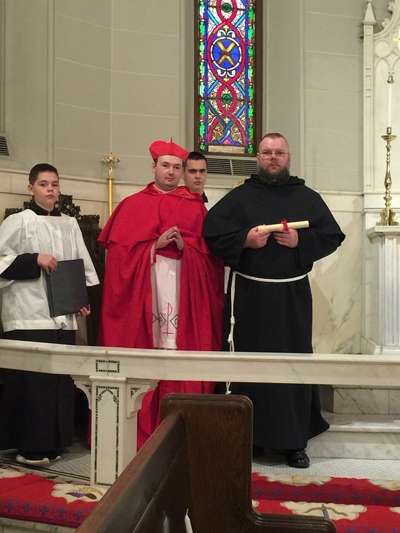
In 2010, the then Archdiocese of the Southwest arranged an external academic pathway for postulants through Trinity School for Ministry in Ambridge, Pennsylvania, an internationally recognized Anglican seminary of the evangelical tradition with a significant Anglo-Catholic presence. The Very Rev. Dr. Justyn Terry, then Dean and President of the seminary and a priest of the Church of England, affirmed in writing that postulants from the Archdiocese of the Southwest would be welcomed and could be placed in suitable Anglo-Catholic field education settings. As he wrote to the Metropolitan of the Southwest at the time, “There are also opportunities for appropriate field education placement for these students.” Although no candidates ultimately enrolled through this pathway, the correspondence reflected the Archdiocese’s ongoing commitment to high academic standards in clergy formation and demonstrated recognition and support by respected external institutions for its evolving clergy-training programme. Click here for the accredidation and intent statement. History continued following the photos below.
The
Evolution of Pontifical Georgian College
In
an era where technology has transformed the way we learn, adaptability
and innovation are key to staying relevant. This is precisely why
the Pontifical Georgian College, which once held onsite
classes
at physical property in San Antonio, Texas, USA, made
the
bold decision some time ago to transition to an online-based model.
Operating solely online allows seminarians access to the college without geographical constraints. This inclusivity ensures that no talented individual is left behind due to their location. The online format provides seminarians with greater flexibility in balancing studies with other commitments such as work or family, empowering them to tailor their learning experience according to their own schedule. Depending on the programme, seminarians may be required to be in residence at an approved parish and may have additional residence requirements. Additionally, all ordination are conducted entirely in person in accordance with the doctrine and laws of the Church. Also,
having long-since moved away from physical property
significantly
reduced operational costs for the College and the Church.
Those cost savings can be redirected into other areas of
need.
PURPOSE AND DEGREES
The purpose of the college is to ensure excellence in education of the clergy of the United Roman-Ruthenian Church. For this purpose, there are five faculties: Sacred Theology, Sacred Philosophy, Canon Law, History, and Sacred Music. Faculty hold the ranks of Professor, Vice Professor, Deputy Professor, or Instructor, according to qualification, experience, and tenure. The college confers the following academic honours: Diplomate: Conferred in Sacred Theology (S.T.Dip.) and Sacred Philosophy (S.Phil.Dip.). The grade of Diplomate of Sacred Theology signifies successful completion of Minor Seminary. There are two tracks, a general one and one for those concurrently undertaking general baccalaureate education. The Diploma of Sacred Philosophy recognizes basic studies in related fields such as history or sacred music. Licentiate: Conferred in Sacred Theology (S.T.L.), Sacred Philosophy (S.Phil.L.), and Canon Law (J.C.L.). The Licentiate in Sacred Theology or its equivalent is the prerequisite for ordination to the priesthood. The Licentiate of Sacred Philosophy recognizes advanced studies in related fields, while the Licentiate of Canon Law recognizes in-depth knowledge in that field. Doctorate: Conferred in Sacred Theology (S.T.D.), Sacred Philosophy (S.Phil.D.), Canon Law (J.C.D.), and Sacred Letters (S.L.D.). The Doctorate of Sacred Letters is exclusively given as an honourific to recognize laymen who have made significant and outstanding contributions to theology and/or religion. The Doctorate of Sacred Theology is the terminal theological honour and signifies advanced, in-depth knowledge of theology. The Doctorate of Sacred Philosophy recognizes significant achievement in study of related fields. The Doctorate of Canon Law represents mastery of Canon Law. All doctoral honours except for the Doctorate of Sacred Letters require original research and successful defense of a dissertation.
HISTORICAL DOCUMENT EXCERPTS The following are historical documents that form part of the Stephenian Archives pertaining to the heritage of the Pontifical Georgian College. These documents are presented here as part of the historical record.   Original document showing details of the college program, with St. Edwin Caudill listed as president. Images copyright URRC 2008.  Summary of theological formation. Image copyright URRC 2008.   Original General Ordination Exam, which formed the basis of the exam used in the United Roman-Ruthenian Church today. Images copyright URRC 2008.  Original St. George's School of Theology question and answer docuement. Images copyright URRC 2008.
Accreditation and Educational Scope The
sole purpose of the College is to provide religious and ecclesiastical
formation for the clergy and lay leaders of the United Roman-Ruthenian
Church and its affiliated jurisdictions. Accordingly, the College does
not seek and does not maintain secular or governmental accreditation.
Its programs, degrees, and credentials are ecclesiastical in nature and
are accredited solely by the Church. [United Roman-Ruthenian Church]
|