|
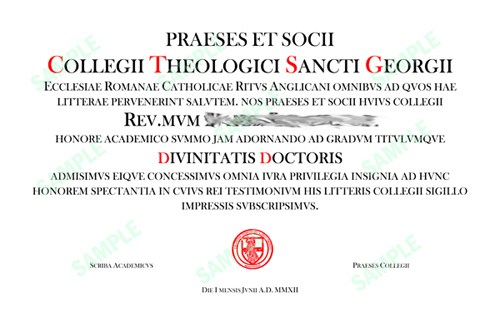
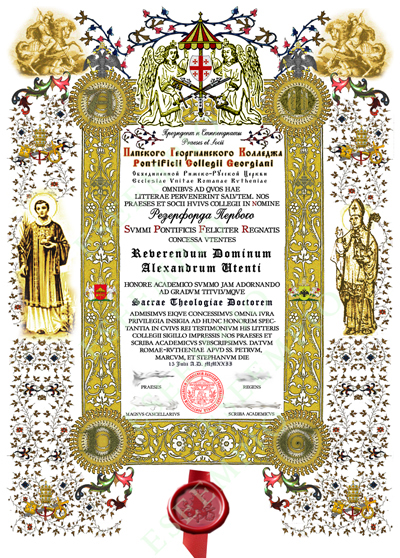
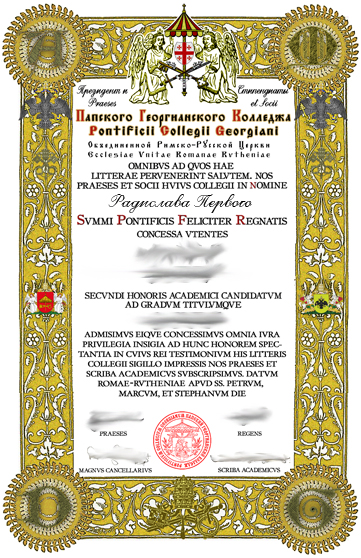
History of the St. George Theological Seminary Supreme Pontiff | Roman-Ruthenian Curia | College of Cardinals | Pontifical Court | Liturgy The Saint George Theological Seminary was founded by St. Edwin Caudill, then Bishop of the Southwest, as St. George's School of Theology. It was maintained beginning in 2008 by the Anglo-Catholic Archdiocese of the Southwest, the legal successor to St. Edwin's diocese, and renamed St. George Theological Seminary. The Archdiocese in time became the Diocese of Rome-Ruthenia, the principle See of the United Roman-Ruthenian Church. The seminary's name in time also changed to Pontifical Georgian College. Yet it remains the successor to the original seminary, carrying its legacy into the future. It remains the principle theological seminary of the Holy Apostolic See of Sts. Peter, Andrew, Stephen, and Mark (United Roman-Ruthenian Church). To read the history of the seminary, see artifacts, and learn about the seminary today, please click here. Note: Above photograph of the original seminary seal copyright URRC 2018. All rights reserved.
A Brief Historical Summary of the Seminary and Ecclesiastical Succession The St. George’s School of Theology was founded as the official seminary of the then-Diocese of the Southwest in 1987, under the episcopal oversight of St. Edwin Caudill, Bishop of the Southwest. The seminary, which was incorporated in the State of Arizona and based at St. Edwin's cathedral, St. Chad's in San Antonio, Texas, USA,
functioned as an extension of the Diocese itself rather than as a
parish-based or other type of institution. This structural relationship
is clearly reflected in its early administrative documents and
records, which consistently identify it as an organ of the
Diocese. As is common for institutions, throughout the years of it
history, the seminary accumulated various historical artifacts and
memorabilia associated with the different periods of the seminary’s
life. These are valued as archival materials that illuminate its past
and its heritage.
Following the repose of St. Edwin and subsequent changes in diocesan leadership, the seminary remained, existing in continuity, eventually continuing in operation under the Diocese of the Southwest (eventually the Archdiocese of the Southwest) within the Apostolic Communion of Anglican Churches in 2008. At that point its English name was changed to St. George Theological Seminary to signal the new era of the seminary, as the jurisdiction, under the leadership of Pope Radislav I of Rome-Ruthenia (then the Rt. Rev. Rutherford Johnson, 5th Bishop of the Southwest, himself not an Anglican), ceased any formal affiliation with the so-called "continuing Anglican" movement, instead embracing the fullness of its Orthodox and Old Catholic lineage. The Metropolitan Archdiocese
was recognized with autocephaly and subsequently recognized as the
Patriarchal See of St. Stephen, no longer geographically tied to the
American southwest. The Patriarchate was also known historically as the
Anglican Rite Roman Catholic Church and the Anglican Patriarchate of
Rome. In the early years of the Patriarchate, the seminary was renamed
Pontifical Georgian College in recognition of its expanded scope. And,
the Patriarchate was one of the jurisdictions that merged in 2023 to
form the unified jurisdiction that became known as the United Roman-Ruthenian Church.
The Diocese of the Southwest, which, by the ecclesiastical concessions
granted to it, evolved into the Diocese of Rome-Ruthenia, inheriting an
ancient ecclesiastical patrimony as Orthodox Latin successor to St.
Peter, and remains the principal See of the Roman-Ruthenian Church and
State. The continuation of the
seminary is attested by the uninterrupted use of its academic
nomenclature, active preservation of faculty and administrative
records, continuity of academic awards and curricula, ongoing
production of theological publications (including the establishment of
St. George Seminary Press in 2008, later renamed Pontifical Georgian Press),
and consistent oversight by the diocesan episcopate and later by the
patriarchate and pontificate. These elements of jurisdictional
governance, academic succession, and documented operation constitute
the seminary’s identity in ecclesiastical law.
The seminary’s continued governance, its consistent academic activity, and its lawful and canonical incorporation within the Diocese of Rome-Ruthenia ensure the integrity of its mission and the faithful preservation of the legacy established in 1987 under St. Edwin Caudill.
For more information on the history of the seminary, see artifacts, and learn about the seminary today, please click here.
[Pontifical Georgian College Main Page]
|