Founding of the Church
The Church is founded by Jesus Christ.
Church · Apostolic Succession · Temporal Patrimony
Key events in the apostolic, ecclesiastical, liturgical, dynastic, and temporal history represented within the modern Roman-Ruthenian Church and Pontifical Imperial State.


This chronology brings together the principal milestones traditionally identified in the history of the Church, its apostolic successions, its liturgical development, and the temporal and dynastic inheritances represented within the Pontifical Imperial State.
How to use the timeline: on a desktop or tablet, scroll horizontally through the chronology. On a phone, the same events appear as a vertical sequence.
From the founding of the Church to the modern United Roman-Ruthenian Church

The Church is founded by Jesus Christ.
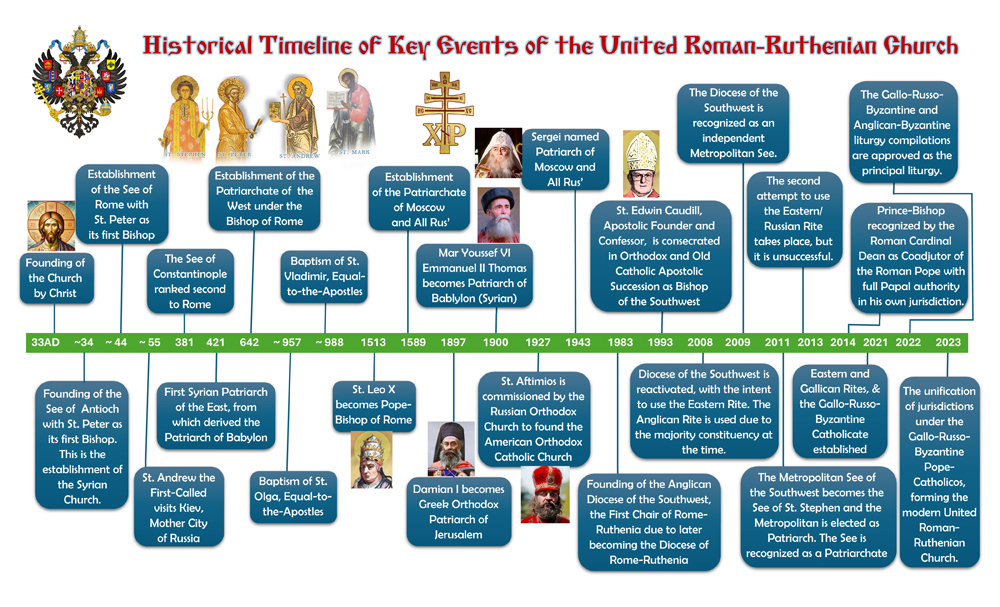
The See of Antioch is founded with St. Peter as its first Bishop. This is the establishment of the Syrian Church.

Establishment of the See of Rome with St. Peter as its first Bishop.
St. Andrew the First-Called visits Kiev, Mother City of Russia.
The See of Constantinople is ranked second to Rome.
The first Syrian Patriarch of the East, from which the Patriarchate of Babylon derived.
Establishment of the Patriarchate of the West under the Bishop of Rome.
Baptism of St. Olga, Equal-to-the-Apostles.

Establishment of the Kingdom of Italy in the Holy Roman Empire.
Baptism of St. Vladimir, Equal-to-the-Apostles.

Danil Romanovich crowned King of Russia by authority of Pope Innocent IV of Rome.

St. Leo X becomes Pope-Bishop of Rome.
Establishment of the Patriarchate of Moscow and All Rus'.

Roman the Great recognized as Tsar and Autocrat of All Rus'.

Damian I becomes Greek Orthodox Patriarch of Jerusalem.

Mar Youssef VI Emmanuel II Thomas becomes Patriarch of Babylon (Syrian).

St. Aftimios is commissioned by the Russian Orthodox Church to found the American Orthodox Catholic Church.

Sergei is named Patriarch of Moscow and All Rus'.

Founding of the Anglican Diocese of the Southwest, the First Chair of Rome-Ruthenia, later becoming the Diocese of Rome-Ruthenia.

St. Edwin Caudill, Apostolic Founder and Confessor, is consecrated in Orthodox and Old Catholic Apostolic Succession as Bishop of the Southwest.
The Diocese of the Southwest is reactivated, with the intent to use the Eastern Rite. The Anglican Rite is used due to the majority constituency at the time.

The Diocese of the Southwest is recognized as an independent Metropolitan See.
The second attempt to use the Eastern/Russian Rite takes place, but is unsuccessful.

The Metropolitan See of the Southwest becomes the See of St. Stephen and the Metropolitan is elected as Patriarch. The See is recognized as a Patriarchate.

Roman-Ruthenian papal authority is recognized.
Eastern and Gallican Rites, and the Gallo-Russo-Byzantine Catholicate, are established.

The Gallo-Russo-Byzantine and Anglican-Byzantine liturgy compilations are approved as the principal liturgy, and the Catholicate is established.

The Gallo-Russo-Byzantine liturgy is established.

The Prince-Bishop is recognized by the Roman Cardinal Dean as Coadjutor of the Roman Pope, with full papal authority in his own jurisdiction.

The jurisdictions are unified under the Gallo-Russo-Byzantine Pope-Catholicos, forming the modern United Roman-Ruthenian Church.