
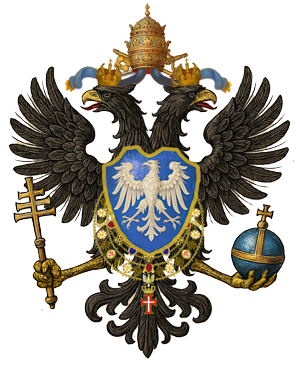
The United Roman-Ruthenian Church (URRC), also known as the Roman-Ruthenian Church and State, maintains a distinct and fully developed system of ecclesiastical nobility and sovereignty. It is a custodial Church and an ecclesiastical sovereignty preserving the spiritual and temporal legacies of the Roman Empire, the Holy Roman Empire, and the Kingdom of Ruthenia.
Structure and Leadership
The Church is governed by a hierarchical order integrating ecclesiastical authority with the historic forms of Christian sovereignty:
- The Roman-Ruthenian Pope is the supreme authority, holding the titles of Prince-Bishop, Pope-Catholicos, and Imperator of Rome-Ruthenia. The current Supreme Pontiff is His Apostolic Highness Pope Radislav I.
- The Patriarchal Electors, which includes the Roman-Ruthenian Sacred College of Cardinals, are entrusted with the election of the Pope-Catholicos, preserving continuity within the apostolic and sovereign order.
- The Patriarchal Curia and Pontifical Court serve as the administrative, judicial, and ceremonial bodies through which governance is exercised.
- The Pontifical Imperial Household safeguards the living heritage of the Church, including its texts, regalia, and historic patrimony, under the immediate authority of the Roman-Ruthenian Papacy.
Noble Ranks and Historical Patrimony
The United Roman-Ruthenian Church functions as a guardian of Christian nobility and the continuity of traditional Christian civilization. Its temporal patrimony is derived from established historical and ecclesiastical inheritances:
- Succession from St. Peter the Apostle and Pope St. Leo X forms part of the Church’s recognized continuity of temporal and ecclesiastical authority.
- The Pontifical Imperial State serves as the non-territorial juridical expression of Roman-Ruthenian sovereignty.
- Through
Apostolic succession, ecclesial grants, and formal recognitions
received over time, the URRC inherited not only orders but
jurisdiction, autocephaly, and custodial responsibility for the Petrine inheritance within the Latin Orthodox tradition.
- The Legacy of Holy Rus’ situates the Church within the historical development of the Third Rome, as heir to the Patriarchal Kingdom of Ruthenia and its broader ecclesiastical mission.
Humanitarian Service, Historical Preservation, and Ceremony
The Church maintains active service institutions that express its mission in the world. These include but are not limited to the following:
- The Pontifical Walsingham Guard, founded in 2012, functions as the principal humanitarian and ceremonial service body, drawing upon both historic tradition and modern charitable engagement.
- Ecclesiastical Nobility and Knighthood
- Ecclesiastical nobility and knighthood constitute structured vocations within the life of the Church, uniting spiritual commitment with active service. They are not honorary in a superficial sense but represent obligations grounded in faith, discipline, and public responsibility.
- Many nobles and knights serve in the Pontifical Court.
Preservation of Tradition
Ecclesiastical ranks preserve the living forms of Christian civilization, including heraldry, ceremonial order, and the institutional memory of the Roman world in all its various manifestations. They ensure continuity where secular systems have largely abandoned these structures.
Recognition of Service and Merit
Ecclesiastical nobility operates within a merit-based framework. Rank is conferred in recognition of demonstrated service to the Church, humanitarian commitment, intellectual contribution, and personal integrity. It establishes a formal structure through which dedication to the Church’s mission is acknowledged and ordered.
Moral and Ethical Framework
Knighthood is inseparable from the discipline of chivalry, which provides a binding moral code:
- Protection of the weak and vulnerable
- Public defense of the Christian faith
- Personal integrity and disciplined conduct
Sovereignty and Institutional Authority
The granting of nobility constitutes an exercise of ecclesiastical sovereignty. The Church possesses the authority to confer rank, recognize service, and govern its own order independent of secular states or external recognition systems. This authority is vested in the Roman-Ruthenian Pope.
Community and Unity
Ecclesiastical orders unite members across nations and cultures within a single mission. They form an international body rooted in shared duty, spiritual identity, and historical continuity.
Historical and Contemporary Role
Ecclesiastical orders as we know them originated in the Middle Ages as organized expressions of Christian defense and service. They historically provided:
- protection for pilgrims
- care for the sick and vulnerable
- the moral ordering of martial society through chivalric discipline
In the modern context, these orders continue as active instruments of:
- humanitarian service
- ecclesiastical recognition
- material and spiritual support of the Church
Threefold Status of Ecclesiastical Nobility
Members of ecclesiastical nobility and knighthood hold a threefold status within the ordered life of the Church:
- Ecclesial Status: They are knights and nobles within the One, Holy, Apostolic, Orthodox, and Catholic Church, participating in the apostolic and sacramental life that transcends jurisdiction and rank.
- Jurisdictional Status: They hold defined rank and office within the hierarchical structure of the United Roman-Ruthenian Church, through which their vocation is ordered and exercised.
- Sovereign Status: They are nobles of the Pontifical Imperial State, sharing in the juridical and sovereign expression of the Church’s temporal and institutional authority.
Recognition of Noble Houses
Historic and contemporary noble houses may be received into ecclesiastical status through formal application and recognition.
Upon acceptance:
- such houses are incorporated into the ecclesiastical order of the Church
- their members are elevated to ecclesiastical nobility
- their standing is no longer dependent upon secular recognition