
ENGLISH - ITALIANO - CASTELLANO - РУССКИЙ
Read more about our vision, mission, and core values by following this link .
WHO
ARE THE PEOPLE OF THE UNITED ROMAN-RUTHENIAN CHURCH?
Find
out by following this link!
WHERE IS THE CHURCH LOCATED?
Find out here!

Q: What is the official status of the United Roman-Ruthenian Church?
The
United Roman-Ruthenian Church is an autocephalous Apostolic Church—the Eastern Roman Church with Latin heritage. It is a canonical patriarchal Church of ancient Orthodox and
Catholic origins.
The United Roman-Ruthenian Church is a contemporary expression of an ancient Apostolic inheritance. Its
official timeline begins with the founding of the Church in AD 33, and
its authority derives from preserved Apostolic succession received
through the ancient patriarchates of Rome, Constantinople, Antioch,
Jerusalem, and their historic extensions into Rus’ and the Americas.
The URRC is a derivative patriarchate formed by the convergence of
these ancient lines through continuity of faith, order, and sacramental
life. Its various constituent
jurisdictions were consolidated in 2023 under the Church’s present
united institutional structure.
The Holy Apostolic See of the United Roman-Ruthenian Church is under
the patronage of Saints Peter, Andrew, Stephen, and Mark, reflecting
both its Eastern and Western inheritance: Peter as patron of Rome,
Andrew as apostle of the East and of Ruthenia, Stephen as patron of the
Diocese of Rome-Ruthenia, the main episcopal jurisdiction of the
Roman-Ruthenian Pope, and Mark as founder of Aquileia and patron of the
papal Metropolitan See. Through Apostolic succession, ecclesial grants,
and formal recognitions received over time, the URRC inherited orders,
jurisdiction, autocephaly, and custodial responsibility for
the Petrine inheritance within the Latin Orthodox tradition. Its
present form is the consolidation of ancient streams into a single
custodial Church, preserving intact what was received.
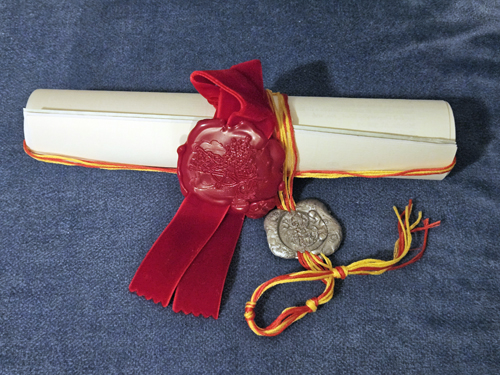
Among the preserved archival holdings
of the Pontifical Chancery are ecclesiastical instruments connected to
the early juridical and patriarchal development of the United
Roman-Ruthenian Church and issued by authorities of the Holy See of
Rome. These pertain to the reception of apostolic jurisdiction,
patriarchal autocephaly, and papal dignity within the continuing
Orthodox and Catholic tradition now embodied in the Roman-Ruthenian
Church and State. These documents are part of the sacred patrimony of
the Church, preserved with care and continuity.
Q: What are the main parts of the United Roman-Ruthenian Church?
The
main divisions of the
United Roman-Ruthenian Church are the Diocese of Rome-Ruthenia and the Catholicate of
Rome-Ruthenia
. Read about who the
Church's people are here.
Q: How can several sees share succession from the same Apostle?
The Apostles founded Churches in many places, and those Churches continued through bishops who preserved the faith and Apostolic succession.
In the earliest centuries of Christianity, the Apostles founded
Churches in many places. Those Churches continued through bishops who
preserved the faith and apostolic succession. Over time, certain major
sees (for example, Rome, Antioch, Alexandria, Constantinople,
Jerusalem) became patriarchates. Apostolic succession consequently
continued through multiple bishops and ecclesiastical jurisdictions.
For example: St. Peter is historically connected to Rome and Antioch.
Both Churches have always regarded themselves as Petrine successors.
Likewise so is the Roman-Ruthenian Church by grant and
recognition. (See more about the Roman-Ruthenian Petrine
succession here and here, as well as on this page.)
St. Mark founded the Church in Alexandria. Today both the Coptic
Orthodox Pope and the Greek Orthodox Patriarch of Alexandria trace
succession to him. St. Mark is also succeeded in Aquileia by the
Roman-Ruthenian Pope (as Metropolitan) and in Venice by the Roman
Catholic Patriarch.
In Armenia, there are both Armenian Apostolic and Armenian Catholic
hierarchies tracing to the same apostolic foundation and likewise both
claiming succession.
Similarly, Eastern Orthodox and Eastern Catholic (Uniate) Churches share apostolic roots in the same sees.
History shows that succession can continue in more than one ecclesial
body, especially where divisions, political shifts, or jurisdictional
reorganizations occurred. Authentic succession is expressed through
the preservation of apostolic faith, sacramental life, and the legitimate
continuity of the inheritance received.
Q: How does this relate to the United Roman-Ruthenian Church as successor to St. Peter?
Through apostolic succession, ecclesial grants, and historical
recognitions, the URRC received custodial responsibility for the
Petrine inheritance within the Latin Orthodox tradition — particularly
in the historic territories of the Western Patriarchate and Holy Rus’.
(See more about the Roman-Ruthenian Petrine succession here and here, as well as on this page.)
This is a consolidation of ancient streams into a visible
Orthodox-Catholic custodial Church preserving what was received.
Just as Rome and Antioch are both historically Petrine, and just as,
for example, multiple Alexandrian successors coexist, the URRC
understands its Petrine role as spiritual and custodial, rooted in
Orthodox and Catholic continuity and exercised as a stewardship of the
inheritance received.
Q: How can several sees share Petrine succession?
Multiple jurisdictions can share authentic succession when history,
ecclesial grants, and continuity support it. Rome and Antioch, for
example, have long preserved distinct expressions of Petrine succession.
The URRC exists to preserve and renew the full Orthodox-Catholic inheritance entrusted
to it, especially where that inheritance has been obscured, fragmented,
or administratively altered.
The Roman-Ruthenian Church receives its succession as a responsibility
to preserve the apostolic faith, sacramental life, and jurisdictional
inheritance entrusted to it.
Q: Is the United Roman-Ruthenian Church the temporal successor of St. Peter the Apostle? What about other Apostles?
The United Roman-Ruthenian Church is in hereditary descent from Rome and Russia and is the temporal successor of St. Peter. Its Petrine temporal inheritance is carried through recognised and documented succession from Pope St. Leo X in the Holy Roman Empire and is joined with the Church's hereditary descent from Rome and Russia.
The
United Roman-Ruthenian Church also has direct Apostolic succession from
other key Apostles such as Andrew, Thomas, Thaddeus,
and
Bartholomew. It is an international ethno-religious community and a
non-territorial ecclesiastical sovereignty representing people across
multiple modern countries. It holds historical rights in relation to
the Roman Empire
as
the temporal successor of St. Peter
,
granting it
specific rights. The temporal heritage of the Church today form the
Pontifical Imperial State of Rome-Ruthenia (see above). As a fully
Orthodox and Catholic autocephalous
(independent) institution, the United Roman-Ruthenian Church possesses
equal authority to other independent Patriarchates, including the Roman
Communion (Vatican)
.
Q: What liturgical rites are used by the United Roman-Ruthenian Church?
The United Roman-Ruthenian Church currently has four primary liturgical rites: the Gallo-Russo-Byzantine Rite, the Anglican-Byzantine Rite, the Anglo-Roman (Anglican) Rite, and the Gallo-Roman (Gallican) Rite. Usually any traditional Orthodox or Catholic liturgical rite may be used.
Q: What is the Pontifical Imperial State of Rome-Ruthenia?
In the rich tapestry of history, the states of the Church transcend time and hold great significance. The Pontifical Imperial State of Rome-Ruthenia is the titular secular wing of the United Roman-Ruthenian Church. It is the Church's unified titular and temporal expression, carrying its inherited patrimony in continuing ecclesiastical form. It is the combination of the historic Pontifical Roman State and the Pontifical Kingdom of Ruthenia and All Rus' to which the Church is heir, carrying a legacy that spans centuries.
To
foster a sense of unity and
represent
all the historical territories associated with the patrimony of the
United Roman-Ruthenian Church (which include various historic states, among which area an empire, three kingdoms,
several principalities, and more)
, the
modern name - Pontifical Imperial State of Rome-Ruthenia - was
chosen. Uniting these historic states under one banner of
fellowship strengthens the bonds of
collective
heritage
within the United Roman-Ruthenian Church and writes a new
chapter in their shared history. Despite our diverse
backgrounds,
we are all part of a greater whole. Today the Pontifical Imperial State
stands as a non-territorial ethno-religious cultural nation and a state
unto itself, representing people across multiple modern countries. Its
public life centers on ecclesiastical, cultural, humanitarian, and
patrimonial service throughout those countries. (See also Temporal Successor of St. Peter above.)
Historical and Canonical Legitimacy
Read more here.
Temporal Rights
Read more here.
The Roman-Ruthenian Papal Title
Read more here.
Q: Why do the United Roman-Ruthenian Church and Pontifical Imperial State continue to use titles of nobility?
The Church’s historic titles express tradition and continuity, linking its present service with the patrimony entrusted to it. They symbolize dedication to service, devotion to faith, and commitment to upholding the principles upon which the Church was founded. (See also the Roman-Ruthenian Nobility Association.)
Q: What is the present role of the Pontifical Imperial State as a non-territorial ecclesiastical sovereignty?
The Pontifical Imperial State is the continuing titular expression of the historic temporal patrimony inherited by the Church. Its present role preserves institutional continuity, ecclesiastical autonomy, diplomatic relations, cultural heritage, and the stewardship of historic Church assets across an international community.
Its non-territorial form reflects the Church’s spiritual and temporal inheritance while respecting the civil governance of the modern countries associated with its historic patrimony. Through this continuing office, the Church participates in international affairs and safeguards the sovereign, dynastic, cultural, and heraldic heritage entrusted to it.
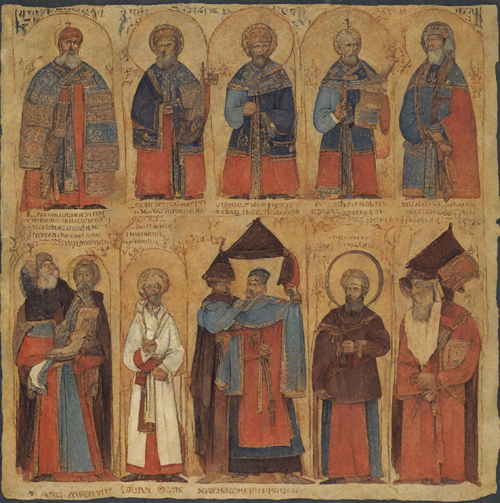
Q: What is the Holy Apostolic See of Saints Peter, Andrew, Stephen, and Mark?
This name refers to the patron saints of the Prince-Bishop as Pope-Catholicos of Rome-Ruthenia and Supreme Pontiff of the United Roman-Ruthenian Church (the Apostles Peter and Andrew the First-Classed), the Diocese of Rome-Ruthenia (whose patron saint is St. Stephen the Apostle and Archdeacon), and the Metropolitan See of Aquileia (whose founder and patron saint is Saint Mark the Apostle and Evangelist). These are the diocesan and metropolitan jurisdictions of the Supreme Pontiff of the United Roman-Ruthenian Church.
Q: Is the Church in the United Nations?The United Roman-Ruthenian Church is an autocephalous ecclesiastical sovereignty with an independent government. It is accredited with special consultative status with the United Nations Economic and Social Council
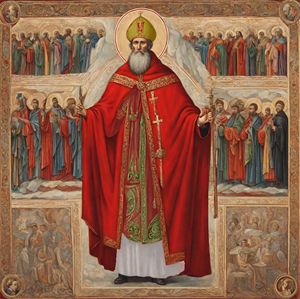
Yes. We are a canonical Orthodox and Catholic Church through adherence to the historic and constant faith of the Church as taught by the saints and the Church Fathers (St. Vincent of Lerins) and the faith once delivered for all unto the saints (Jude 3). Canonical standing rests in the preservation of that Apostolic faith, sacramental life, and historic order. We receive as canonical all who faithfully preserve this traditional inheritance.

The United Roman-Ruthenian Church belongs to the continuous Church founded by Jesus Christ. Within that Apostolic continuity, the Apostolic founder of our principal diocese is Saint Edwin Caudill. He brought his Anglican See (Diocese of the Southwest) into Orthodox and Catholic Apostolic heritage. That diocese evolved in time into the Diocese of Rome-Ruthenia. Find out more here.
Q: Who are the Holy Fathers of the Apostolic See?
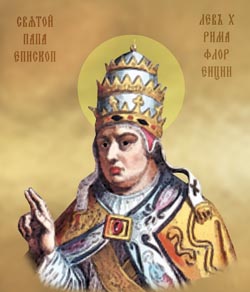
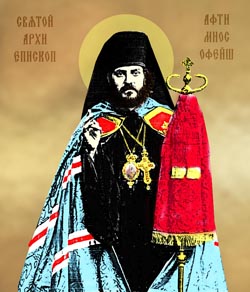
Pope Saint Leo X and Saint Archbishop Aftimios Ofiesh are known as the two Holy Fathers of the Apostolic See. Find out more here.
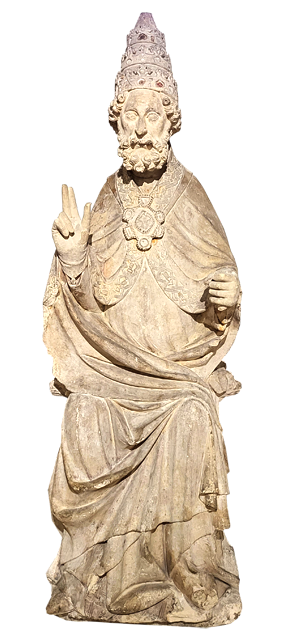
Diocese of Rome-Ruthenia
St. Stephen the Deacon and Protomartyr - 3 August and 26 December
Metropolitan See of Aquileia
St. Mark the Apostle - 25 April
United Roman-Ruthenian Church and Catholicate of Rome-Ruthenia
Sts. Peter and Andrew, Apostles - 29 June and 30 November
Pontifical Imperial State
Sts. Peter and Paul, Apostles - 29 June
Pontifical Kingdom of Ruthenia
St. George, Martyr - 23 April
Apostolic Founder
St. Edwin Caudill - 25 October
Holy Fathers
Pope St. Leo X and St. Archbishop Aftimios - 1 December and 24 July
Q: How does the United Roman-Ruthenian Church relate to other churches?
Administratively independent and sovereign, the United Roman-Ruthenian Church embraces as brethren other Catholic, Orthodox, and Anglican bodies, such as the current Roman Communion (commonly referred to as the Roman Catholic Church), the Anglican Ordinariate, Eastern Orthodox Churches, and the Anglican Communion.
Q: Who is the head of the United Roman-Ruthenian Church?
The Prince-Bishop of
Rome-Ruthenia
(Roman-Ruthenian Pope) is Supreme Pontiff of the United Roman-Ruthenian Church.
A: Both states are permitted, both for bishops and other clergy, in accordance with the Apostolic Canons and early Church practices. For more information on canonical married bishops and clergy, please see this article.
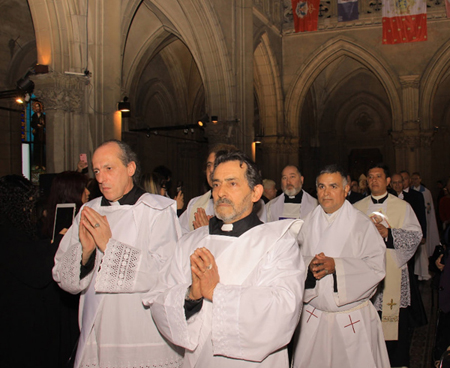
Q: What is the basis for the Church's traditions, vestments, titles, and ceremonial customs?
The traditions, vestments, titles, and ceremonial customs of the United Roman-Ruthenian Church belong to its own Apostolic, patriarchal, and historical inheritance. They express the Church's continuity of faith, order, sacramental life, and public service across its Eastern and Western heritage.
Q: How does the United Roman-Ruthenian Church approach relations with other Churches and religions?
The United Roman-Ruthenian Church promotes informed understanding, Christian charity, and mutual respect among Christian Churches and between religions. Education, faithful dialogue, and respect for each community's historical inheritance support unity, cooperation, and service to the common good.
[ Main Page ]
DISCLAIMER, LEGAL, AND COPYRIGHT NOTICES