Johnson-Roma-Rus’: a study of Old Russian origins, westward migration, and enduring ecclesiastical and dynastic continuity.
A visual summary of the House’s dynastic continuity.
A Legacy of Old Russian Origins
History carried through family, culture, and evidence
Throughout history, noble lineages have risen, fallen, and sometimes vanished into obscurity—fragmented by conquest, exile, or political upheaval. Yet legacies endure in chronicles, family traditions, cultural identity, and the genetic record carried by descendants.
The family overall is of Roman and Old Russian heritage. Historical and genetic research, coupled with analytical techniques, suggests that the House’s direct paternal lineage is also rooted in Old Rus’ before an eventual westward migration into France, Britain, and beyond. The genetic inquiry includes Y-DNA SNP analysis, public population datasets, and comparative haplogroup research.
Research into trade routes, military movements, and genetic markers suggests that the lineage may have belonged to a westward movement of Norse-Rus’ warrior elites. A likely point of origin is the Novgorod–Pskov region during the formative period of the Rus’ polity.
Origins in Kievan Rus’
The Norse-Rus’ aristocracy and the formation of the medieval Rus’ world
The story begins in the Old Russian State, commonly called Kievan Rus’, where Norse, Slavic, and Byzantine cultures formed a powerful and complex medieval society (Franklin & Shepard, 1996). The Varyagi or Varangians—Norse adventurers, traders, and warriors—became integrated with Slavic populations and the ruling structures of the Rus’ lands (Duczko, 2004).
By the tenth and eleventh centuries, the Rurikovichi governed much of Eastern Europe, oversaw major trade networks, and deepened relations with Byzantium. Internal struggles among princes, pressure from the steppe, and the gradual transformation of Old Russia prompted some noble and warrior families to seek opportunity elsewhere (Ostrowski, 2002; Martin, 2008; Vernadsky, 1973). Some moved toward Byzantium; others followed western routes into the heart of Europe (Curta, 2006).
Westward Migration
From Rus’ toward France through established military and commercial networks
The family may have formed part of a later movement of Norse-descended elites travelling west after long integration within Slavic and Byzantine spheres (Blöndal & Benedikz, 2007). Historical trade routes and patterns of military service provide two plausible pathways.
The Dnieper–Black Sea Route
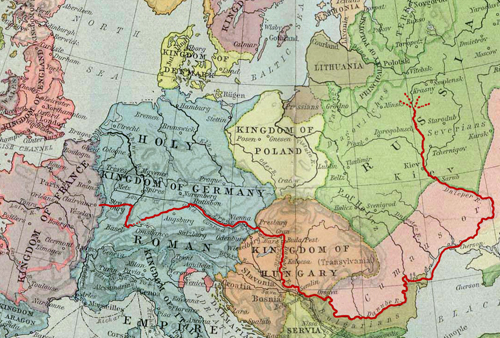
Travellers could move south along the Dnieper through important trade centres to the Black Sea, then westward through the Danube basin, Hungary, the Holy Roman Empire, and Frankish territories (Wood, 2022). A related path could pass through Constantinople before turning west.
The Baltic–Scandinavian Route
A northern alternative would pass through Novgorod into the Baltic, through Denmark, and eventually toward Normandy or Frankish lands. Although possible, it appears less consistent with the routes commonly associated with Rus’-Varangian elites moving through continental Europe.
The most plausible reconstructed migration route is marked in red.
Arrival in Champagne
A strategic settlement within the feudal and commercial world of medieval France
By the eleventh century, Champagne had become a major political and economic centre. Its trade fairs and proximity to Norman-controlled territories created opportunities for newcomers to enter the feudal aristocracy through service, alliance, and marriage. The available evidence suggests a Rus’-descended lineage connected to Eastern Norse networks rather than directly to the original Scandinavian-Norman settlements.
Unlike many Norman and French aristocratic families with well-documented Scandinavian roots, the lineage appears in eleventh-century Champagne without a clear direct Norman origin (Krause & Trappe, 2021). A rare Nordic paternal haplogroup now concentrated chiefly in the Balkans is consistent with a route through the broader Norse-Rus’ military and commercial world.
New Beginnings
France, Britain, Scotland, and beyond
After becoming established in France and developing ties with the Norman world, the family became involved in the transformations surrounding the Norman Conquest of England in 1066. In time, descendants moved into Scotland and again attained local prominence.
The migration continued across centuries. Descendants established themselves in Britain, North America, and the Caribbean, preserving inherited identity while adapting to new countries and institutions.
The Genetic and Dynastic Echo of Old Rus’
Interpreting the documentary and population evidence together
Historical records and genetic markers indicate a distinctive combination of Roman, Russian, Norse, and wider European ancestry. Beyond the direct paternal line, other genetic connections link the family with noble Eastern European and Mediterranean populations.
The later ecclesiastical role of the House reconnected it institutionally with its ancient eastern inheritance. As ecclesiastical heirs within the Roman-Ruthenian Church and State, the House claims continuity associated with Rome, Byzantium, and the ancient Kingdom of Rus’, predating the later Tsardom and Russian Empire (Shepard, 2007).
Methodological Note. This study integrates traditional documentary and genealogical records with historical reconstruction informed by scientific analysis, genetic evidence, historical information, population data, and statistical probability. These complementary forms of evidence are distinguished where appropriate and evaluated together to reconstruct lineage and historical movement across periods for which the surviving documentary record is necessarily incomplete.
Continuity
The Rurikid and Romanovich inheritance lives on
Research using public genetic reference data, admixture studies, haplogroup distributions, and historical studies of Norse and Varangian migration offers a clearer picture of movement across medieval Europe. The combined evidence is consistent with an east-to-west migration from the world of Kievan Rus’ around the eleventh century, even though gaps remain in the conventional written record.
Surnames and political landscapes changed, but the inheritance adapted and endured. Genealogical documentation, genetic study, and historical reconstruction together illuminate movements that shaped aristocratic lineages across Europe.
Epilogue
The Johnson or Zhonson name in Imperial Russia
Separately from the documented ancestry of the House of Johnson-Roma-Rus’, several Johnson families became established in Imperial Russia through education, military service, and court circles. Their surname was often rendered in Russian as Жонсон and transliterated as Zhonson, whereas the House uses the more phonetically exact Джонсон, transliterated as Dzhonson.
These families may or may not share a distant relationship with the House; no such connection can presently be established with confidence. Their history nevertheless demonstrates that the surname was neither unknown nor anomalous within the Russian Empire.
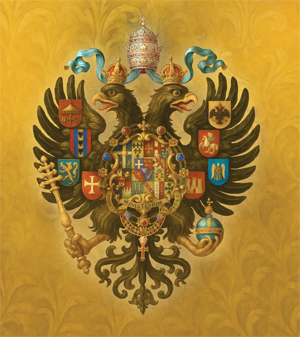
Arms associated with the Pontifical and Imperial House.
Documentation
Select references
Blöndal, S., & Benedikz, B. (2007). The Varangians of Byzantium. Cambridge University Press.
Curta, F. (2006). Southeastern Europe in the Middle Ages, 500–1250. Cambridge University Press.
Duczko, W. (2004). Viking Rus: Studies on the Presence of Scandinavians in Eastern Europe. Brill.
Franklin, S., & Shepard, J. (1996). The Emergence of Rus 750–1200. Longman.
Krause, J., & Trappe, J. (2021). A Short History of Humanity. Random House.
Logan, F. D. (2005). The Vikings in History (3rd ed.). Routledge.
Martin, J. M. (2008). Medieval Russia, 980–1584. Cambridge University Press.
Ostrowski, D. (2002). Muscovy and the Mongols. Cambridge University Press.
Shepard, J. (Ed.). (2007). The Expansion of Orthodox Europe. Routledge.
Vernadsky, G. (1973). The Origins of Russia, Volume 1: Kievan Russia. Yale University Press.
Wood, I. (2022). The Merovingian Kingdoms and the Mediterranean World. Bloomsbury.
Select core data foundations
Research drew upon population studies from the Human Genome Diversity Project, 1000 Genomes Project, and Simons Genome Diversity Project; haplogroup data from YFull, ISOGG, and public FamilyTreeDNA projects; scholarly reconstructions of Viking and Varangian movement; population calculators and admixture models including Eurogenes, MDLP, and Dodecad; medieval charters, feudal records, MedLands, Généanet, and prosopographic databases; and comparative ancient-genome research published in journals including Nature, Science, and PLOS Genetics.
The United Roman-Ruthenian Church and the Pontifical Imperial State of Rome-Ruthenia constitute an ecclesiastical sovereignty by right of Rome as heir to the Roman Empire and the Pontifical Kingdom of Ruthenia and All Rus’.