
Archival and Genealogical Study
Johnson in Imperial Russia
The Johnson or Zhonson family in the educational, military, and court circles of the Russian Empire.

Scope of the Study
The Johnson or Zhonson Family in Imperial Russia
The following concerns several Johnson families who became established in Imperial Russia through education, military service, and court circles. These are separate from the documented ancestry of the House of Johnson-Roma-Rus’. Their surname was frequently rendered in Russian at the time as Жонсон and transliterated as Zhonson, whereas the House of Johnson-Roma-Rus’ uses the phonetically accurate Russian form Джонсон, transliterated as Dzhonson. These families that became established in Tsarist Russia in the 18th century and later may or may not share some distant connection with the House, but no such relationship can presently be established with confidence. Their history nevertheless demonstrates that the surname was neither unknown nor anomalous within the Russian Empire. Even without a proven genealogical link, the parallel remains noteworthy in light of the House’s own westward migration from Old Rus’ and its later ecclesiastical reconnection with Old Russia. This history is therefore maintained as part of the House’s broader interest in preserving Johnson history wherever it intersects with themes central to its own heritage and the enduring presence of the Johnson name across those historical settings.
The Russian Johnson family, whose surname appears variously as Zhonson, Johnson, Жонсон, and Джонсон, can be traced securely to Johann F. G. Johnson, later known in Russia as Ivan Ivanovich Zhonson. He was born in Warsaw in 1769 and entered Russian imperial service near the end of the eighteenth century. In St. Petersburg he worked as a teacher of German at institutions including the First Land Cadet Corps and the Alexander Cadet Corps, eventually attaining the civil rank of titular councillor.[1] His position indicates that he was an educated and socially respectable immigrant, although the family’s formal prominence in Russia was established gradually through imperial service rather than through immediate recognition as a great foreign noble house.
Johann’s descendants formed a notable Russian military family. His son Alexander Ivanovich Zhonson became a colonel and commanded the 1st Battalion of the Field Marshal Prince Barclay de Tolly Carabinier Regiment. Alexander’s son, Nikolai Alexandrovich Zhonson, whose surname reportedly appeared as “de Johnson” on a French-language visiting card, served as an officer in the 3rd Guards and Grenadier Artillery Brigade.[2]
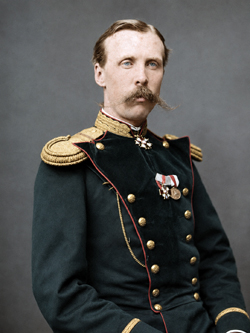
The best-known member of this branch was Nikolai Nikolaevich Zhonson (1878–1918), who was educated at the Alexander Cadet Corps and the Mikhailovsky Artillery School. After serving as an artillery officer, he became a close aide and secretary to Grand Duke Michael Alexandrovich. He accompanied the grand duke into confinement at Perm and was abducted and murdered with him during the night of June 12–13, 1918.[3]
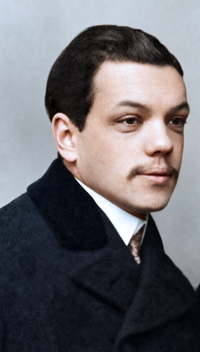
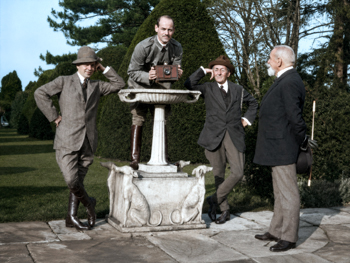
Other prominent imperial officers bore the same surname, although their precise relationship to Johann’s immediate branch is not always established in the published material. A surname search in the Russian Ministry of Defense’s Great War database returns nearly 300 records under Johnson/Zhonson spelling variants, although these entries may include duplicate references, enlisted personnel, and individuals belonging to unrelated families.[8] Konstantin Wilhelmovich (or Vasilievich) Zhonson rose from captain to colonel and reportedly retired with the rank of major general in 1910. His son, Konstantin Konstantinovich Zhonson, graduated from the Imperial Naval Corps and served as an officer of the Caspian Flotilla, reaching the rank of lieutenant during the First World War.[4] Herbert (Gerbert) Georgievich Johnson (1857–1919), a Lutheran nobleman born in Helsingfors, reached the rank of lieutenant general. He commanded the 20th Galician Infantry Regiment, later led the 27th Infantry Division, and received both the St. George Weapon and the Order of St. George, Fourth Class.[5] Taken together, these records show that the Johnson or Zhonson surname was well represented in Imperial Russian military service and that several of its bearers reached the senior military-service elite by the late nineteenth and early twentieth centuries.
However, the family’s ancestry before Johann’s birth in Warsaw remains unknown. His education and occupation place him within a German-speaking Central European milieu, but language does not establish German paternal ancestry. Significantly, the inherited surname appears in the recognizably British form Johnson, rather than as Johannsen, Jansen, or another characteristically German surname. A British origin is therefore plausible. Among the possible British points of origin, Scotland deserves particular consideration because considerable numbers of Scots migrated to and settled in the Polish–Lithuanian Commonwealth between the sixteenth and eighteenth centuries. They included merchants, soldiers, clergy, scholars, and members of gentle or noble families; many subsequently integrated into Polish, German-speaking Protestant, or other local communities.[6][7]
A reasonable working hypothesis is therefore that the Russian Johnsons or Zhonsons descended from a family originating in Britain, possibly, and in the context of British migration to Poland, perhaps more plausibly, in Scotland. Among the possible British points of origin, Scotland is historically more plausible than England. English commercial involvement with the Polish–Lithuanian Commonwealth was substantial, particularly through the Baltic ports and the Eastland Company, but it did not produce a settler diaspora comparable to the widespread Scottish communities established throughout the Commonwealth. This is a key distinction probabilistically.[9]
Over several generations, such a family could have intermarried locally and entered a German-speaking cultural and religious environment before Johann moved from Warsaw into Russian imperial service. This would provide a coherent explanation for the British-looking surname, Johann’s Warsaw origin, his command of German, and the family’s successful entry into educated Russian service.
Nevertheless, no known surviving documentary chain currently identifies Johann Johnson’s parents or traces his ancestry before Warsaw. The Scottish hypothesis is historically credible and fits the broader pattern of Scottish migration and assimilation in the Polish–Lithuanian Commonwealth, but it remains unproven. The history of the Johnson or Zhonson families in Imperial Russia is preserved here as a related chapter in the wider history of the Johnson name. Whether or not the families involved share an ancestral connection, their broader resemblance is nonetheless striking: both involve movement between the Western and Eastern European worlds, connections with the lands of Poland and Russia, and the establishment of the Johnson name within the context of Russian history. The House therefore maintains this history as part of a wider duty to preserve and present Johnson history where it relates meaningfully to its own cultural, dynastic, and Old Russian inheritance.
[1] I. V. Papulov, “JOHNSON–ДЖОНСОН–ЖОНСОН в России XIX века,” Perm State Archive of Social and Political History. The archival reconstruction identifies “Johnson Iohan F. G.” as a native of Warsaw, born in 1769, and records his work as a German-language instructor and his rank of titular councillor.
[2] Papulov’s reconstruction traces the line through Alexander Ivanovich and Nikolai Alexandrovich. The Perm archival introduction also describes a surviving visiting card belonging to Nikolai Alexandrovich bearing the form de Johnson.
[3] For Nikolai Nikolaevich’s birth, education, artillery service, and connection to Grand Duke Michael Alexandrovich, see the biographical entry compiled from Imperial Army materials and the Perm archival exhibitions. The Perm sources date their murder to the night of June 12–13, 1918.
[4] The published account of Konstantin Konstantinovich records his birth in 1887, Naval Corps education, assignment to the Caspian Flotilla, promotion to lieutenant, and his father’s advancement from captain to colonel and retirement as a major general. The 1909 Imperial Army index independently lists Konstantin Wilhelmovich Zhonson as a colonel.
[5] “Джонсон Герберт Георгиевич,” Офицеры русской императорской армии. The entry identifies him as a nobleman of Petrograd Province, a graduate of the Nicholas Engineering School and General Staff Academy, a regimental and divisional commander, a lieutenant general, and a recipient of the principal St. George distinctions. The published evidence does not establish his precise genealogical relationship to Johann’s branch.
[6] Peter Paul Bajer, Scots in the Polish-Lithuanian Commonwealth, 16th–18th Centuries: The Formation and Disappearance of an Ethnic Group (Leiden: Brill, 2012). Bajer examines the scale, social composition, religious affiliations, citizenship, naturalization, ennoblement, and gradual assimilation of Scottish settlers in the Commonwealth.
[7] A. Francis Steuart, ed., Papers Relating to the Scots in Poland, 1576–1793 (Edinburgh: Scottish History Society, 1915).
[8] Ministry of Defense of the Russian Federation, Pamyati geroev Velikoi voiny 1914–1918, “Search for War Heroes.” A search under Johnson/Zhonson spelling variants returned nearly 300 database records. These should not be treated as 300 distinct members of a single family: the results may contain multiple records for the same person, non-officers, transcription variants, and unrelated surname bearers.
[9] English relations with the Polish–Lithuanian Commonwealth were especially important in Baltic commerce. J. K. Fedorowicz notes that almost 85 percent of English Baltic shipping at the beginning of the seventeenth century was directed toward ports of the Polish Commonwealth, particularly Elbing and Danzig. This substantial English commercial presence should nevertheless be distinguished from the more broadly settled and assimilated Scottish diaspora examined by Peter Paul Bajer.
Related records
Documentary and legal context
The United Roman-Ruthenian Church and the Pontifical Imperial State of Rome-Ruthenia constitute an ecclesiastical sovereignty by right of Rome as heir to the Roman Empire and Pontifical Kingdom of Ruthenia and All Rus’ with an independent government in special consultative status with the United Nations Economic and Social Council. The United Roman-Ruthenian Church is an autocephalous Catholicate.
Crown, International, and United States Copyright © 2008–2026. All rights reserved. Legal, copyright, and trademark notices.